
A country without gadhas
An animal that used to roam the streets of India freely is now found in zoos because it's become so rare. But why does that matter? (Reading time: 5 mins)

Government offers upto Rs 50 lakh for donkey farming
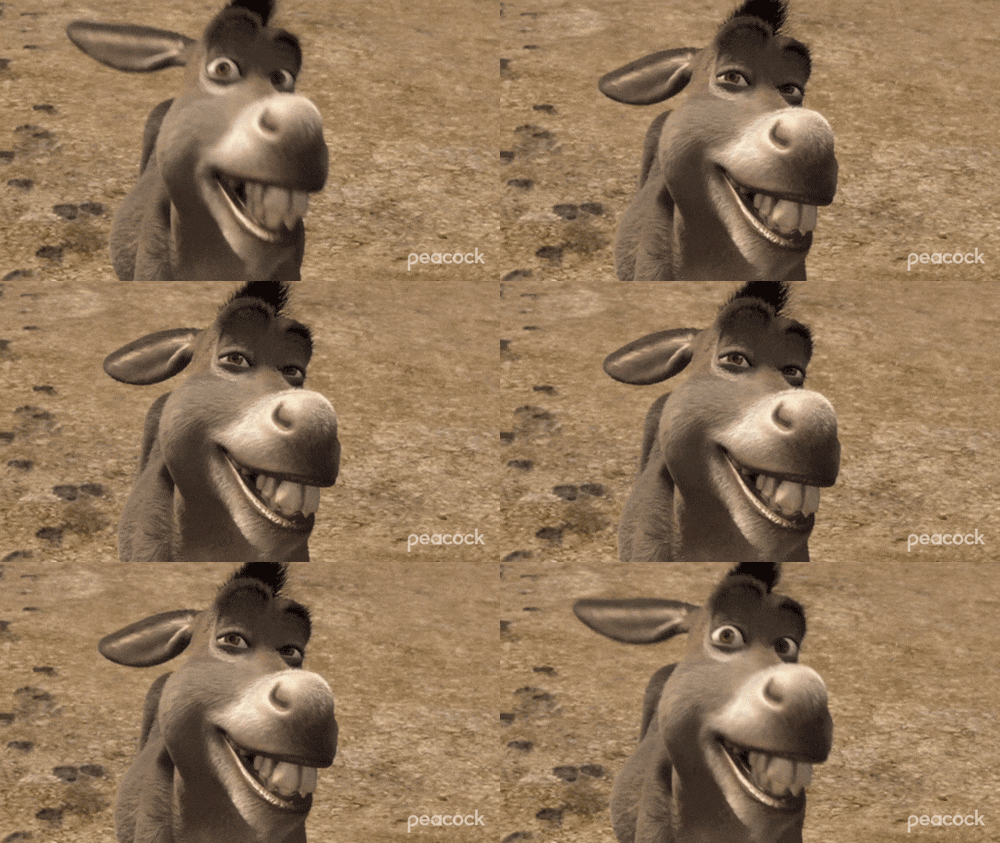
I recently bought a small ceramic plant pot shaped like a donkey carrying a beautiful, tiny succulent. It was love at first sight. The moment I saw that donkey, I was drawn to its quirkiness.
I was immediately transported to my childhood home in Faridabad where donkeys used to roam around on the streets right outside our house. I can still remember their “dhen-choo” “dhen-choo” ringing in my ears. That was early 2000s.
Now I live in Hyderabad and a quarter of a century later, I can’t remember when I saw a donkey the last time. They have simply vanished from city life. The villages that were earlier part of India’s small towns don’t keep donkeys anymore. The role they used to play of carrying load and transportation is now taken care of by tractors and trucks.
But why am I talking about donkeys this week?
Because their population is shrinking (down by 60% as per the last 2019 Livestock Census - don’t know current numbers) and the government of India is offering subsidies of upto Rs 50 lakh to entrepreneurs and farmers to save them.
What’s the big deal if donkeys become extinct?
Historically and even today in some communities, animals are considered part of rural households. They had certain duties towards the household like carrying load (donkeys, mules, camels) or transportation (bullock carts) or oil extraction (bull-driven, cold-pressed oils). They are/were loved like family members even when they become old and unable to work.
In climate parlance, these were/are low-carbon, low-energy, climate-smart ways of doing things. In contrast, their alternatives like trackers, trucks, bikes, cars and machines have an insatiable appetite for fuel (whose burning emits a lot of CO2), lead to mining of iron, copper, rare earth materials etc., just to be manufactured and cause pollution (a.k.a horrible air quality).
The idea is not to return to some glorious past but to recognize that in some contexts using donkeys and other native species to carry out activities would be a better choice than machines and fuel-driven vehicles to contain our emissions.
Modern systems assume infinite cheap fuel. But climate change, heatwaves, oil shocks, wars like the Hormuz crisis, supply chain disruptions etc. expose how fragile fuel-based systems are.
As per Indian tradition, a village was said to have 8 types of wealth -
- धन (मुद्रा/currency)
- धान्य (grains)
- पशुधन (livestock)
- विद्या (knowledge)
- कारीगरों का कच्चा माल (raw material used by artisans)
Further, livestock or पशुधन itself is of four types:
- गौ धन (cattle)
- अश्व धन (horses)
- गज धन (elephants)
- अज धन (goats & sheep)
I’d like to consider donkeys as part of अश्व धन because they are close cousins of horses. Scientifically speaking, they belong to the same family (equidae) and genus (equus) and are usually owned by people who can’t afford horses.
And so, the donkey was not just an animal, it was wealth. For centuries, donkeys powered India’s informal economy, carrying bricks at construction sites, transporting salt across harsh pans, moving goods through mountain trails, helping small farms, supporting pottery and artisan communities, and even aiding waste collection.
But there is much more to lose if the donkey becomes extinct.
Can you imagine a future where a Hindi-speaking parent says to their child, “Tum gadhe ho.” And, the child just stares back at them, blank and confused.
They don’t know what a “gadha” is. They have never seen one. The whole meaning of a beautiful word used to describe a certain type of person would have lost its meaning and its usage.
How will the future prime minister of India, who is a baby right now, know that sometimes in diplomacy, gadhe ko bhi baap banana padta hai? That is, sometimes in moments of crisis, you have to even flatter the stupidest of heads of states to get what you need.
That wisdom carried over from generations will be lost with the animal it started with.
How will a young 40-something standing for elections understand that in certain elections, competence isn’t required. He/she just needs to be slightly less absurd and they’ll be crowned gadhon mein raja (a king among fools).
How will the future billionaire of India know that one can promise to do their bit, but then skip taxes, and still maintain a haloed public image? That when tax season arrives, he too can disappear like gadhe ke sir se seeng (vanishing in times of need).
And finally, how will country heads know that meaningful climate action is always promised in gadhe ke varsh (a very very long time)? Like 2070 or 2100 etc.
With the animal, vanishes all this wisdom which is an inherent part of how Indians see the world and speak about it.
In Indian folklore, the donkey appears often. Sheikh Chilli wandering into trouble on his donkey. Mulla Nasiruddin riding through villages, half philosopher, half fool, always accompanied by one. Panchatantra-like worlds where animals were not decorative creatures but carriers of wisdom, humour and social commentary. The donkey existed deeply in the Indian imagination.
But what happens when a child has never actually seen one?
Will the donkey slowly become like the unicorn? A creature children recognize from cartoons and idioms but not from streets, farms or villages. Something halfway between memory and mythology.
And when that happens, what else disappears with it? Not just the animal, but an entire vocabulary of metaphors, folk humour, rural life and everyday wisdom that once tied humans closely to the living world around them.
Every extinction first happens in the economy, then in language, and finally in memory.
Why does the government want to save the donkey?
The government is offering a 50% subsidy upto 50 lakhs if you want to build a donkey farm with atleast 50 female donkeys and 5 male donkeys.
Other than conserving an indigenous breed that helps in transportation, there are other reasons donkeys are being reared in regions around the world that may have inspired this government initiative.
For milk, for instance. Donkeys make very little milk but their milk sells for a premium. I am not aware of its nutritional value and didn’t want to spend time researching about it, lest donkeys become the new cows.
The other commercial use is using donkey hide/skin to get gelatin for traditional Chinese medicines. Imagine the irony though, being bred in a farm to be killed for human use. Isn’t extinction better than that, after all?
******
That’s all for today! Thanks for reading another edition of Break the Bubble — after a long hiatus!
Hope to see you in the next edition.
Recommendation of the week
This Hindi poem on different kinds of donkeys found in India, shared by one of our readers:
An illustration portraying what our waste is doing to our animals and our bodies
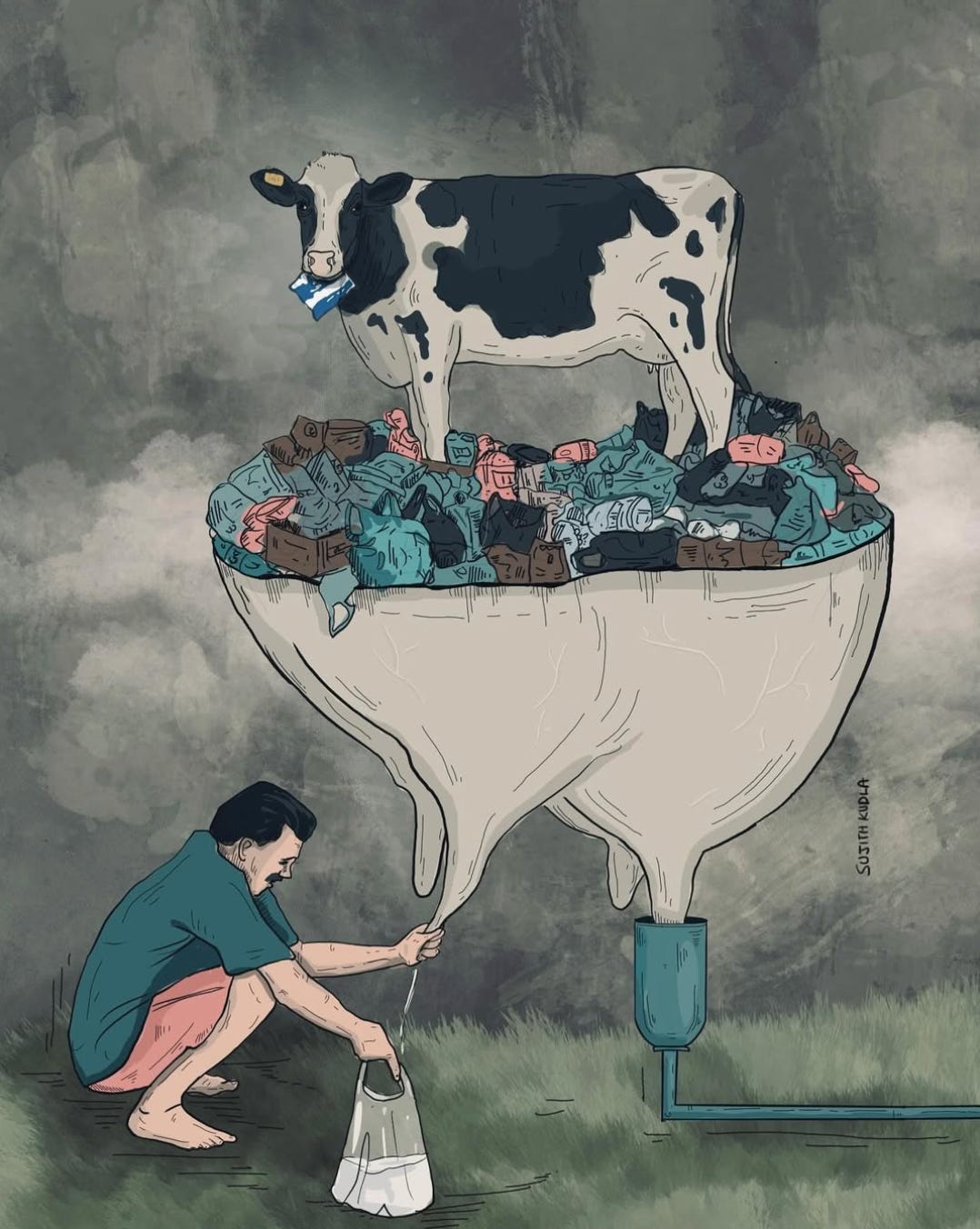
This beautiful illustration shows what we put out in the world comes back to us. Our cows feed on plastic waste that we so casually throw out everyday and that plastic enters our bodies through the cow milk we buy for our family.
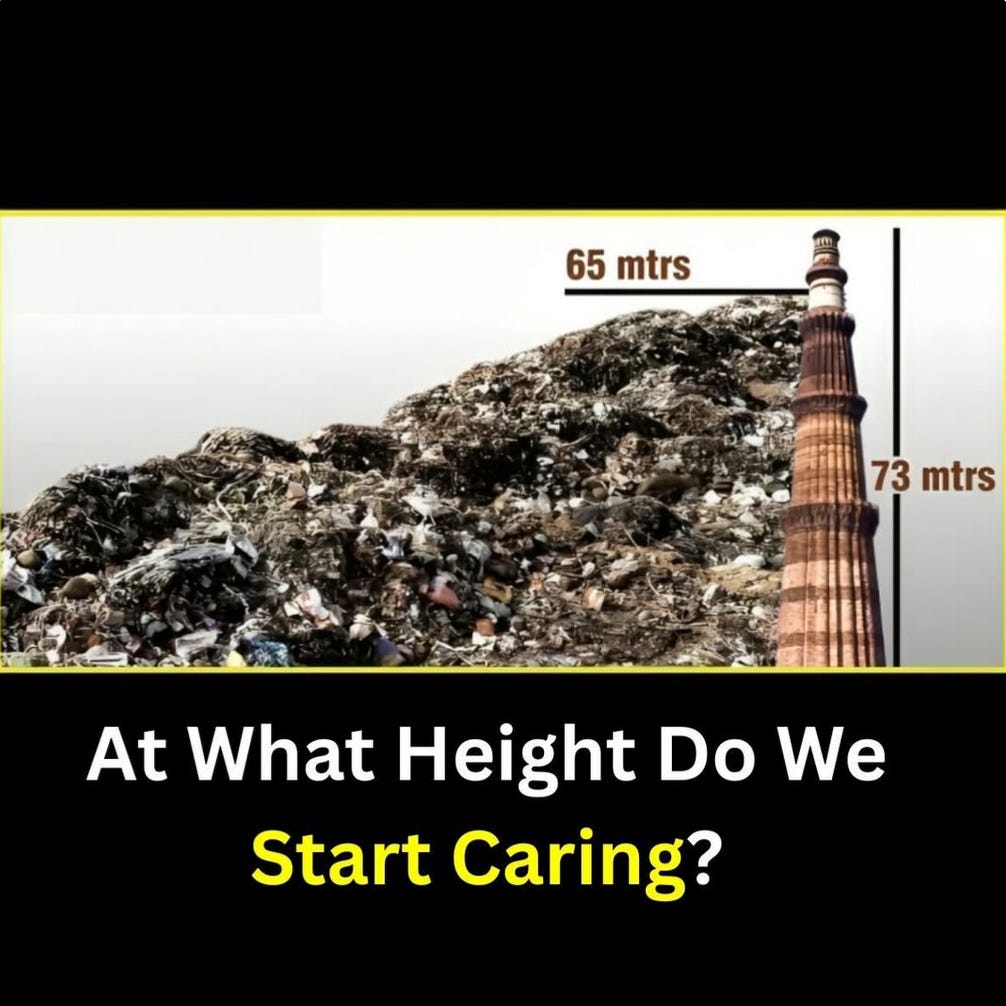
We consume so much plastic in various forms that we end up creating these mountains of toxicity. Like the Ghazipur landfill in Delhi which is continuously compared to the height of the Qutub Minar.
What can you do instead?
When you feel the urge to buy something new, think - do you really need it? More likely than not, it will have some plastic component to it. If nothing else, atleast plastic packaging.
Look for plastic alternatives - there are quite a few now. In clothing, instead of polyester, think cotton, hemp, bamboo. In cutlery, furniture and interiors, think crop-waste (corn, wheat, rice husk)made stuff or bamboo. In party decorations, think upcycled fabric. Instead of plastic bottles, carry own steel, glass resuable ones. If you’re ready to go one step further, carry your own steel dabbas to buy groceries - there are specific kirana stores that still sell loose instead of in branded plastic packs. It takes a bit of effort to find these alternatives but it’s worth it.
If you can’t help but buy that plastic thing or something in a plastic bag, remember to segregate the waste so the plastic can be recycled (or atleast the illusion of being recycled).
Forward this post to someone who should read it!